Get Ready to Lose Your Job
March 30, 2026
AI is coming for your job. This is not doomerism – it is reality.
I posted this idea just twice on X. The first time: 700,000 impressions. The second time: 3.5 million. Same message, same data, same author. The difference? Timing.
And timing is what this whole post is about. The timing of when you’ll lose your job. The timing of when the world is ready to hear it. The timing of everything.
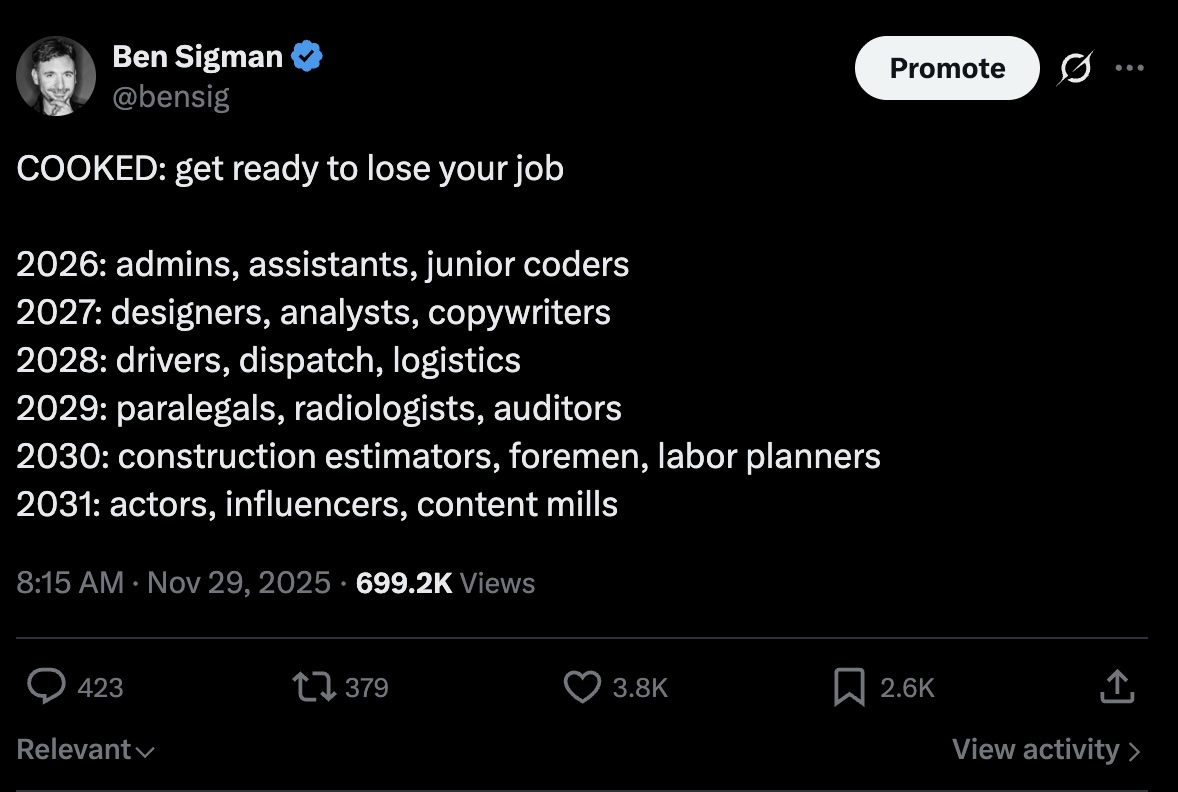
In November 2025, I tweeted a year-by-year timeline of which jobs AI would kill and when. It got 701,000 impressions – a strong post by any measure. The comments ranged from “no way” to “this is a conservative timeline, it will happen way faster than that” to even “yes! please take my job!!”
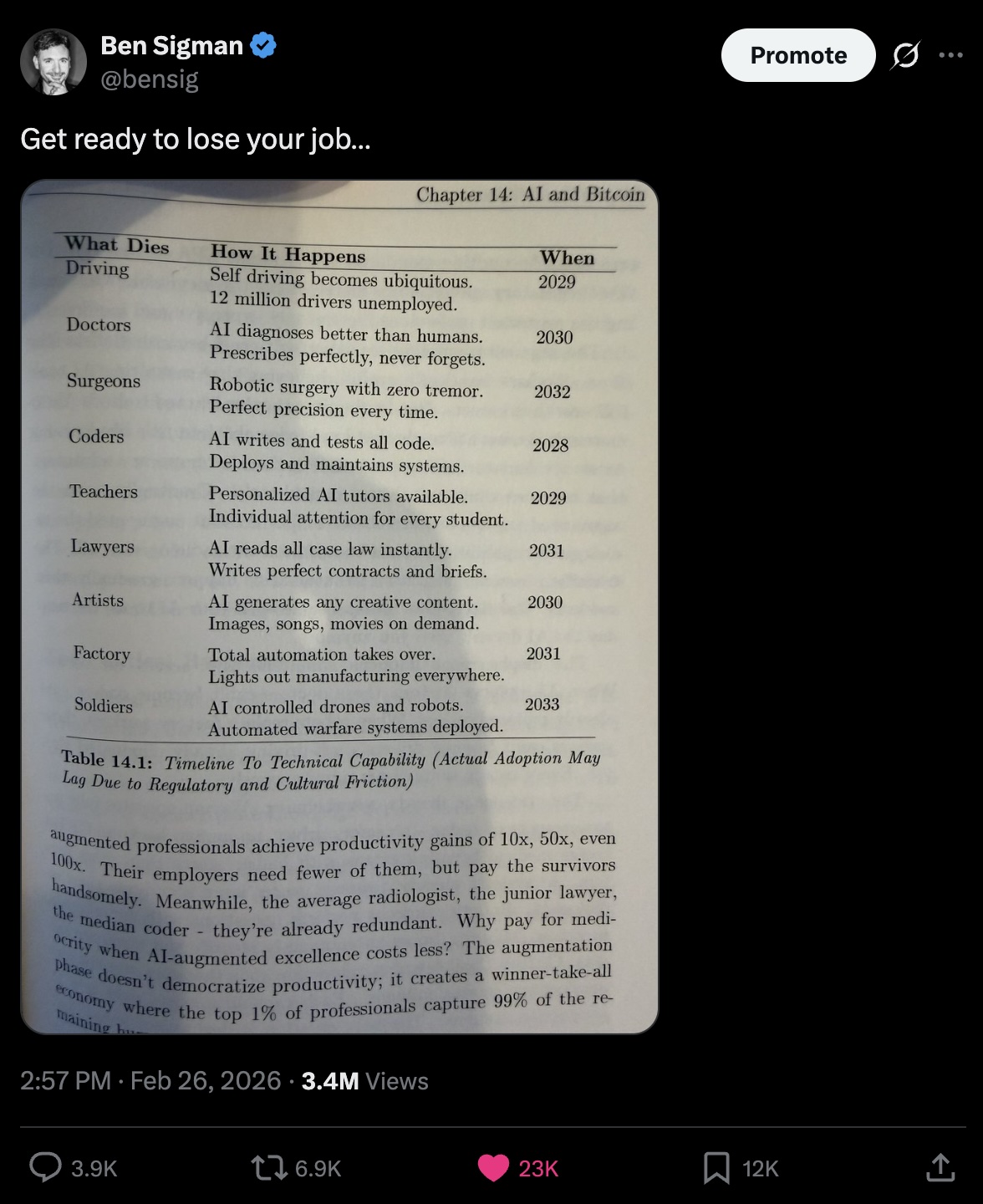
Three months later, on February 26, 2026, I remixed the same idea – this time sharing the table from Chapter 14 of Bitcoin One Million, the book Fred Krueger and I had published months earlier. Same thesis. Better packaging. And it landed on the exact day that Square announced it was laying off 50% of its workforce – 4,000 people gone in a single press release.
3.5 million impressions.
23,000 likes.
4,100 comments.
6,900 reposts.
My second most viral post ever.
The internet didn’t care about my timeline in November. By February, they were living it. Content doesn’t go viral because it’s right – it goes viral because the audience is ready to hear it. Like everything else in this story: timing.
The Timeline
When we wrote Bitcoin One Million, we included a chapter on AI and labor. Here’s the table we published:
| What Dies | How It Happens | When |
|---|---|---|
| Coders | AI writes and tests all code. Deploys and maintains systems. | 2028 |
| Driving | Self driving becomes ubiquitous. 12 million drivers unemployed. | 2029 |
| Teachers | Personalized AI tutors available. Individual attention for every student. | 2029 |
| Doctors | AI diagnoses better than humans. Prescribes perfectly, never forgets. | 2030 |
| Artists | AI generates any creative content. Images, songs, movies on demand. | 2030 |
| Lawyers | AI reads all case law instantly. Writes perfect contracts and briefs. | 2031 |
| Factory | Total automation takes over. Lights out manufacturing everywhere. | 2031 |
| Surgeons | Robotic surgery with zero tremor. Perfect precision every time. | 2032 |
| Soldiers | AI controlled drones and robots. Automated warfare systems deployed. | 2033 |
Table 14.1: Timeline To Technical Capability (Actual Adoption May Lag Due to Regulatory and Cultural Friction)
And the shorter version I tweeted:
- 2026: admins, assistants, junior coders
- 2027: designers, analysts, copywriters
- 2028: drivers, dispatch, logistics
- 2029: paralegals, radiologists, auditors
- 2030: construction estimators, foremen, labor planners
- 2031: actors, influencers, content mills
As we wrote in the book: augmented professionals achieve productivity gains of 10x, 50x, even 100x. Their employers need fewer of them, but pay the survivors handsomely. Meanwhile, the average radiologist, the junior lawyer, the median coder – they’re already redundant. Why pay for mediocrity when AI-augmented excellence costs less? The augmentation phase doesn’t democratize productivity; it creates a winner-take-all economy where the top 1% of professionals capture 99% of the remaining business.
It’s Happening
This isn’t theoretical anymore. Square cut 4,000 jobs in a single day. Coding bootcamps are shutting down. Junior developer hiring has cratered. Design agencies are running skeleton crews. The first wave – admins, assistants, junior coders – landed right on schedule.
But here’s the thing nobody in my replies wanted to hear:
This isn’t the interesting part.
What Humans Are Still Good For
AI outputs are only as good as their inputs. And the inputs that matter most – the ones that separate a generic AI output from something that actually moves people – those are profoundly human.
AI can generate a thousand images. A human knows which one makes you feel something.
AI can write a technically perfect legal brief. A human knows which argument will resonate with this judge in this courtroom.
AI can compose music in any style. A human knows when to break the rules – when the wrong note is the right note.
There’s a French phrase for this: je ne sais quoi. Literally, “I don’t know what.” It’s the thing you can’t name but you recognize instantly. The quality that makes something feel alive rather than assembled.
This is what humans bring:
Taste. AI can produce anything. Humans know what’s worth producing. The ability to curate, to say “not that, this” – that’s not a skill AI is learning. It’s the skill that makes AI useful.
Context. AI knows everything that’s been written. Humans know what matters right now, to this person, in this moment. Context isn’t data. It’s lived experience.
Intent. AI optimizes for whatever metric you give it. Humans decide what’s worth optimizing for. The question “what should we build?” will always be more important than “how do we build it?”
Trust. People buy from people. Patients want a human doctor to look them in the eye. Clients want a human lawyer who understands their fear. The work changes, but the relationship doesn’t.
Judgment under uncertainty. AI excels when the problem is well-defined. Humans excel when the problem hasn’t been defined yet – when you’re operating in fog, making bets with incomplete information, navigating politics and emotion and ambiguity.
The Real Shift
The jobs that disappear are the ones that were always about execution – doing the thing that someone else decided should be done. The jobs that remain are the ones about deciding what should be done and why.
This is actually good news, if you’re paying attention.
The people who will thrive aren’t the ones who can do the most work. They’re the ones who can direct AI to do the right work. The orchestrators. The people with taste, vision, and the judgment to know when the AI is wrong – which it will be, often, in ways that matter.
I build AI-powered products every day. I ship apps from my phone using AI agents. And the thing I’ve learned is this: the AI does 90% of the work, but the 10% I contribute – the decisions about what to build, how it should feel, what to cut, when it’s done – that 10% is everything.
Without it, you get slop. With it, you get something that matters.
So What Do You Do?
If your job is mostly execution – mostly doing what you’re told in a predictable pattern – start moving up the stack. Learn to direct, to curate, to decide. Learn to be the human in the loop whose judgment actually changes the output.
If you’re already there, lean in. Get comfortable working with AI. Learn what it’s good at (everything repeatable) and what it’s bad at (everything that requires taste, timing, and trust).
The wave is coming. The timeline is real. But humans aren’t useless – we’re just being promoted. From doing the work to deciding what work is worth doing.
That’s not a loss. That’s an upgrade.
And if it doesn’t work out? I guess we’ll all learn frisbee golf and take turns massaging each other – two things that robots probably won’t be as fun to do with as another human.
The job displacement timeline is from Chapter 14 of Bitcoin One Million, co-authored with Fred Krueger. The original tweets: Nov 29, 2025 (701K impressions) and Feb 26, 2026 (3.5M impressions).